
Why Screenless Bands Convert Better in Bulk Programs: Comfort, Battery, and Lower Support Burden

Screenless Fitness Band OEM/ODM | Bulk Deployment | App‑First Dashboards | Easy Channel Messaging
When you sell wearables in bulk, the biggest success factor is rarely “more features.” It is wear compliance (people keep wearing it), low maintenance (less charging friction), and low support burden (fewer misunderstandings, fewer returns, fewer tickets). That is why screenless fitness bands have become a high-conversion category for distributors, corporate wellness programs, and private label catalogs.
A screenless wearable keeps the wrist experience clean and minimal and moves the “product experience” into the app. This structure often converts better in large programs because it reduces daily friction and simplifies what channel partners need to explain. This article breaks down the commercial reasons screenless bands perform well, and how B2B buyers can build a stable assortment without smartwatch complexity.
BROWSE OUR WORK
Explore our screenless wearable lineup for private label programs.
Request a Quote | Download Catalog
1) What “Screenless” Really Means in a Bulk Program
A screenless band is not “less capable.” It is a different product logic:
- the band collects data quietly on the wrist
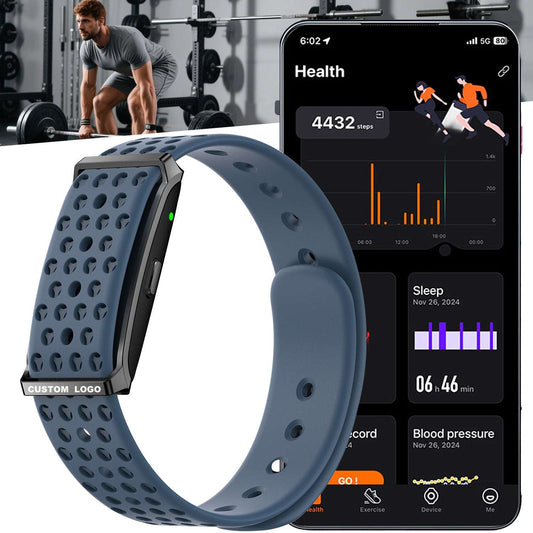
- the user reviews dashboards, trends, and records in the phone app
- the band remains simple, comfortable, and low distraction
In bulk programs, this often works better than a watch-style product because:
- end users do not need to learn an on-device interface
- customers are less likely to expect a smartwatch experience
- onboarding becomes “pair, wear, sync, review” rather than “navigate menus”
For distributors, that simpler logic becomes a stronger sales story: the product is easy to understand and therefore easier to sell at scale.
2) Reason #1: Comfort Drives Wear Compliance (Wear Compliance Drives Results)
Bulk wearables succeed when users keep wearing them long enough to create meaningful trends in the app. Screenless bands often win here because the on-wrist experience stays minimal.
Why comfort converts in real channels
In many catalogs, buyers are comparing multiple bands that appear similar. The one that feels easiest to wear all day tends to win:
- less “watch feeling”
- less visual distraction
- easier sleep wear for overnight tracking routines
- higher acceptance for office and lifestyle settings
In corporate wellness and distributor programs, higher wear compliance usually leads to:
- better program participation
- better review performance
- fewer “I stopped using it” outcomes
- stronger reorder confidence
Screenless design supports this by reducing the number of reasons users remove the device.
3) Reason #2: Battery Story Is Stronger and Easier to Maintain
Battery life is one of the first things a channel buyer looks at and one of the most common sources of customer disputes. Screenless products naturally support longer wearing routines because there is no full on-wrist display power draw.
Why this matters commercially
For bulk programs, battery performance affects more than user satisfaction:
- fewer charging complaints
- fewer returns triggered by “battery doesn’t match expectations”
- less customer support time explaining charging behavior
- better long-term retention, because users charge less frequently
Screenless positioning also supports simpler, more consistent messaging:
- “charge less, wear more”
- “low-maintenance routine”
- “app-first viewing”
Those are easy phrases for distributor sales teams to repeat consistently.
4) Reason #3: Lower Support Burden vs Display-Heavy Wearables
In mass distribution, support cost is often the hidden factor that determines whether a wearable program is profitable.
Display products can generate support questions such as:
- how to change screens and settings
- what a certain icon means
- why the screen is not showing something
- whether the device is “broken” when it is actually a settings issue
Screenless bands reduce the on-wrist UI layer, so support issues shift toward a simpler set:
- pairing
- syncing
- understanding that the app is the main dashboard
That is easier to standardize with a quick start card, a QR onboarding link, and a short FAQ.
5) Screenless Makes Channel Messaging Cleaner (Better Catalog Conversion)
In distributor catalogs, the “first 3 seconds” matter. Screenless products are easier to position because they can be sold with a clean identity:
- Minimal look: wearable accessory, not a gadget
- App-first: dashboards and trends in the phone
- Low distraction: designed for daily routines
- Battery advantage: long wearing cycles
This is especially effective for:
- lifestyle retail
- corporate wellness programs
- sleep-friendly positioning
- wellness-first assortments
A screenless band also avoids competing directly with major smartwatch brands on screen size and watch UI, which is often an unfair comparison in price-sensitive channels.
6) SKU Expansion Is Easier: Same Platform, Multiple Looks
Screenless platforms are often used to build multi-SKU assortments with clear visual differentiation while keeping the user experience consistent.
Common differentiation methods:
- strap material identity: silicone vs nylon vs braided
- colorways: core colors for volume + seasonal colors for refresh cycles
- accessory styling: bracelet-led looks vs sport-led looks
- packaging tier: standard pack vs retail box vs gift-ready kit
For distributors, this is valuable because it supports:
- channel-exclusive variants
- seasonal updates without changing the core workflow
- consistent sales training across multiple SKUs
A multi-SKU strategy works best when each SKU has one “reason to exist,” not a long list of minor spec differences.
7) The Best Screenless Use Cases (Where Conversion Is Usually Strongest)
Screenless bands typically perform well in the following B2B scenarios:
Corporate wellness rollouts
- simple onboarding
- high wear compliance
- low maintenance expectations
Distributor catalog volume pages
- easy “core model” positioning
- stable reorder rhythm
- minimal training burden for sales teams
Lifestyle retail and daily wear positioning
- clean wrist look
- minimal “tech rejection” from non-gadget buyers
- sleep-friendly story without screen glow
Outdoor and athleisure assortments
- strap identity creates shelf differentiation
- durability-led positioning supports higher perceived value
8) What Causes Returns in Screenless Wearables (And How to Prevent Them)
Screenless bands reduce many issues, but returns can still happen when the product expectation is not set clearly. The most common triggers are:
“I thought it had a screen.”
Prevention: put “screenless, app-first dashboard” in the first lines of the listing and on the insert card.
“I don’t know where to see my data.”
Prevention: make the app onboarding steps the center of unboxing: download app, pair, sync, view dashboard.
“Battery doesn’t match what I expected.”
Prevention: use routine-based battery wording and keep the same wording on product page and packaging.
“Water resistance misunderstanding.”
Prevention: keep water-resistance messaging consistent with the model’s rated level and include basic care lines such as “do not use while charging.”
These steps are simple, but they protect reviews and reorder performance.
9) Recommended Screenless Models
Different channels need different anchors in a screenless lineup.
ETQ01 — Core Screenless Volume Model
A mainstream screenless band designed for broad distribution and repeat orders, with app-based daily wellness dashboards and multi-sport positioning for mass-market catalogs.
ETQ05 — Slim Minimalist Model
A comfort-first screenless band with a slimmer feel for lifestyle retail and daily wear programs where wrist comfort drives conversion.
ETQ08 — Sleep + SpO₂ Focus Model
A screenless wellness band positioned around sleep-friendly wear and SpO₂ trend viewing in the app, suitable for wellness-led campaigns and monitoring-first assortments.
ETQ07 / ETQ07‑M — Outdoor Strap Identity Models
Screenless outdoor models built for athleisure and sport-forward channels, using strap identity to create stronger shelf differentiation while keeping an app-first workflow.
ETQ10 / ETQ10‑P — Premium Insight Tier
Advanced bands positioned for HRV and app-based report storytelling, supporting a premium step-up tier for recovery-style positioning.
ETQ16 — AI Recording Differentiation Model
A screenless band that adds a productivity hook alongside wellness dashboards, designed for business, travel, and corporate gifting channels.
10) How to Use Screenless Bands in a Distributor SKU Ladder
A distributor-friendly ladder is easy to teach:
- Core volume: the model that fits the widest audience
- Comfort or style upgrade: the model that wins on wear feel and appearance
- Story upgrade: outdoor identity or sleep focus
- Premium tier: HRV and report storytelling for higher perceived value
This structure improves upsell while keeping the category consistent and avoiding smartwatch complexity.
11) Certifications and Documentation (B2B Note)
Certification documentation varies by model and target market. Final labeling and channel requirements vary by destination country and channel policy.
FAQs
10 FAQs for Screenless Band Wholesale Programs
-
Why do screenless bands convert well in bulk programs?
They reduce daily friction through a minimal wrist experience and app-first dashboards, which supports wear compliance and lower support burden. -
Do screenless bands still support full tracking?
Yes. Screenless bands can support daily wellness tracking and sport records through the app workflow. -
How do users view data without a screen?
Users sync to the companion app to view dashboards, trends, and records. -
Are screenless bands suitable for sleep wear?
Yes. Many buyers prefer screenless designs for sleep-friendly routines and lower distraction. -
Is battery performance a major selling point for screenless bands?
Yes. Screenless concepts support low-maintenance daily routines and strong battery positioning in catalogs. -
Do screenless bands reduce customer support tickets?
They often reduce UI-related support because there is no complex on-device interface, and the workflow is primarily pairing, syncing, and viewing in the app. -
How do distributors prevent “I thought it had a screen” returns?
By stating “screenless, app-first dashboard” clearly on listings and including a quick start card in packaging. -
Can distributors build multi-SKU programs with screenless bands?
Yes. Strap identity, colorways, and packaging tiers allow multi-SKU expansion while keeping a consistent platform experience. -
Is health data medical-grade?
No. Health data is for wellness reference only and not intended for medical diagnosis or treatment. -
What is the fastest way to start a screenless program?
Launch with one core model and one upgrade model, keep packaging simple, and standardize onboarding copy for the app-first workflow.